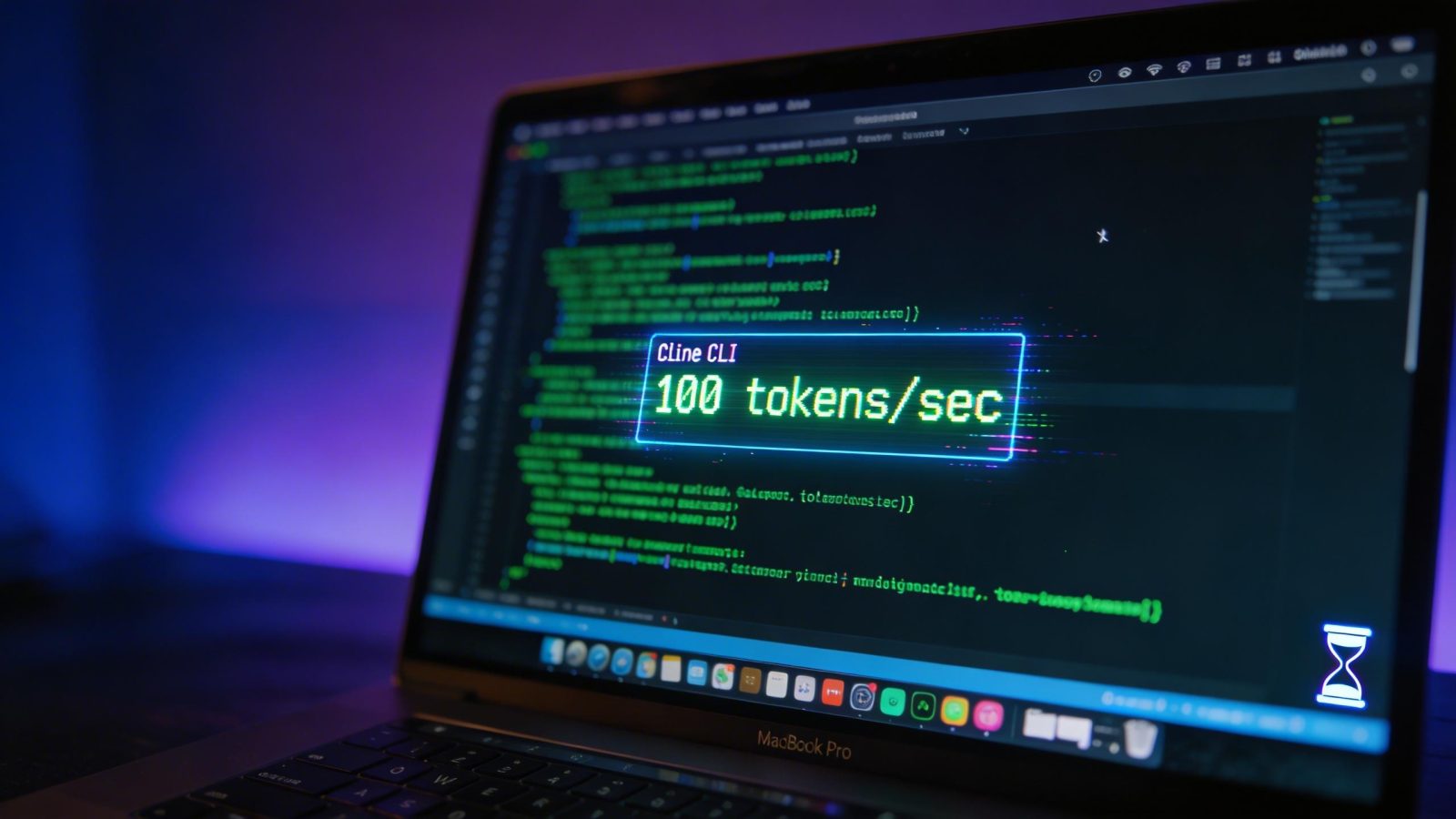
Cline CLI 2.0 launched February 13, 2026 with a promise most developers have heard before: free access to cutting-edge AI, no API keys required. This time it’s MiniMax M2.5 and Kimi K2.5 running directly in your terminal—fast, autonomous, and completely frictionless. Just eight days after ClawCon drew hundreds of developers to San Francisco for laptop tattoos and lobster merch, Cline shipped the practical manifestation of that hype.
The catch? That free access won’t last. Cline won’t say when it ends or what you’ll pay after.
This is the terminal AI gold rush colliding with the economics every developer knows is coming: the paywall. And it reveals something bigger than one product launch—it shows how “democratized” developer tools are really just time-limited user acquisition plays dressed up as indie empowerment.
MiniMax M2.5 hits 100 tokens per second—and nobody’s talking about it
The speed is real. MiniMax M2.5 processes at 100 tokens per second, according to Cline’s February 12 blog post—roughly three times faster than Claude Opus for the same agentic workflows. That’s not incremental. That’s the kind of performance gap that makes terminal-based AI feel instant instead of sluggish.
But grassroots adoption signals tell a different story than enterprise momentum. The Cline CLI 2.0 demo video pulled 2.2K views in its first 24 hours—respectable for a developer tool, but nowhere near viral. This is indie devs and early adopters testing the waters, not teams migrating production workflows.
And that makes sense. Terminal agents like Cline target developers who want more control, not less—the opposite audience from investors pouring $280M into no-code AI. Even Linus Torvalds is vibe coding now, favoring fast prototyping over IDE lock-in. But speed alone doesn’t solve the hard part: knowing when terminal autonomy actually works.
The 10-minute timeout shows where “autonomy” breaks
Cline CLI 2.0 ships with a 600-second timeout for CI tasks—10 minutes to run tests, fix failures, and ship. That’s not a bug. It’s a design constraint that defines what terminal agents are actually good for right now.
Quick scripts? Yes. Prototyping? Absolutely. Complex builds that take 20 minutes and require context across 40 files? Not yet.
The parallel agent architecture mirrors patterns from the Claude Code creator’s workflow, where multiple models tackle subtasks simultaneously. But production pipelines don’t fit neatly into 10-minute windows. GitHub Copilot’s IDE integration still wins for long-running builds because it doesn’t time out—it just waits.
And here’s the other friction point nobody’s shouting about: Node.js 22+ is required. If you’re running Node 18 or 20 in production, you’re blocked. That’s not a “zero-barrier” entry—it’s a technical gate that contradicts the accessibility pitch.
Free access ends—Cline just won’t say when
The February 13 launch post promises “limited-time” free access to MiniMax M2.5 and Kimi K2.5. No end date. No post-trial pricing. No disclosure of what happens when the trial expires.
That’s not democratization. That’s user acquisition.
Indie developers will build workflows around free terminal access, integrate Cline into their daily routines, and train their muscle memory on commands that only work while the promotion lasts. Then the API key requirement kicks in—and they’ll face a choice: pay up or migrate to another tool and lose the workflow they’ve built.
This isn’t unique to Cline. It’s the same playbook GitHub Copilot and Cursor ran: free trials convert users into paying customers because switching costs are real. But as AI targeting high-skill jobs accelerates, the promise that free tools will “level the playing field” rings hollow when the paywall arrives on an undisclosed schedule.
Terminal agents are real. The speed is real. The ClawCon energy—hundreds of developers trading laptop stickers and arguing about agentic workflows—is real. But so is the expiration date on free access. And Cline’s betting most developers won’t notice until they’re already hooked.