
Anthropic’s newest release, Claude Sonnet 4.6, transforms the accessibility of artificial intelligence in a significant way. Capabilities that once belonged exclusively to high-end models are now open to everyone, marking a pivotal moment in the evolution of AI. Thanks to improvements in performance, usability, and affordability, Claude Sonnet 4.6 emerges as a compelling choice across industries—from software development to daily productivity.
What makes Claude Sonnet 4.6 stand out?
This model narrows the divide between advanced features and broad public access. By offering near-premium intelligence at an affordable price point, Anthropic positions Claude Sonnet 4.6 as a benchmark that challenges traditional pricing strategies within the AI sector.
The democratization of technology previously restricted by paywalls creates new opportunities for startups, small teams, and enthusiasts alike. Now, robust coding assistance, sophisticated document handling, and context-aware interactions do not demand premium subscriptions.
Main technical advancements in Claude Sonnet 4.6
Several key upgrades distinguish this version from its predecessors and competing platforms. Claude Sonnet 4.6 matches the sophistication of top-tier models while introducing efficiencies that save both resources and time.
Performance gains are supported by strong benchmarks and notable progress achieved over the past sixteen months, highlighting how quickly Anthropic’s models have matured.
Improved coding and reasoning abilities
Claude Sonnet 4.6 excels in complex programming environments. Insights from experienced developers highlight its ability to handle extensive codebases—tasks traditionally reserved for costly AI solutions. Large projects involving multiple files or intricate logic can now be managed with Sonnet 4.6 without compromising on quality.
Users report that the model demonstrates fluency in long-term code evaluation and revision, supporting projects throughout their entire lifecycle. Work that once required significant computational resources is now achievable with far greater efficiency.
Efficiency on practical office and productivity tasks
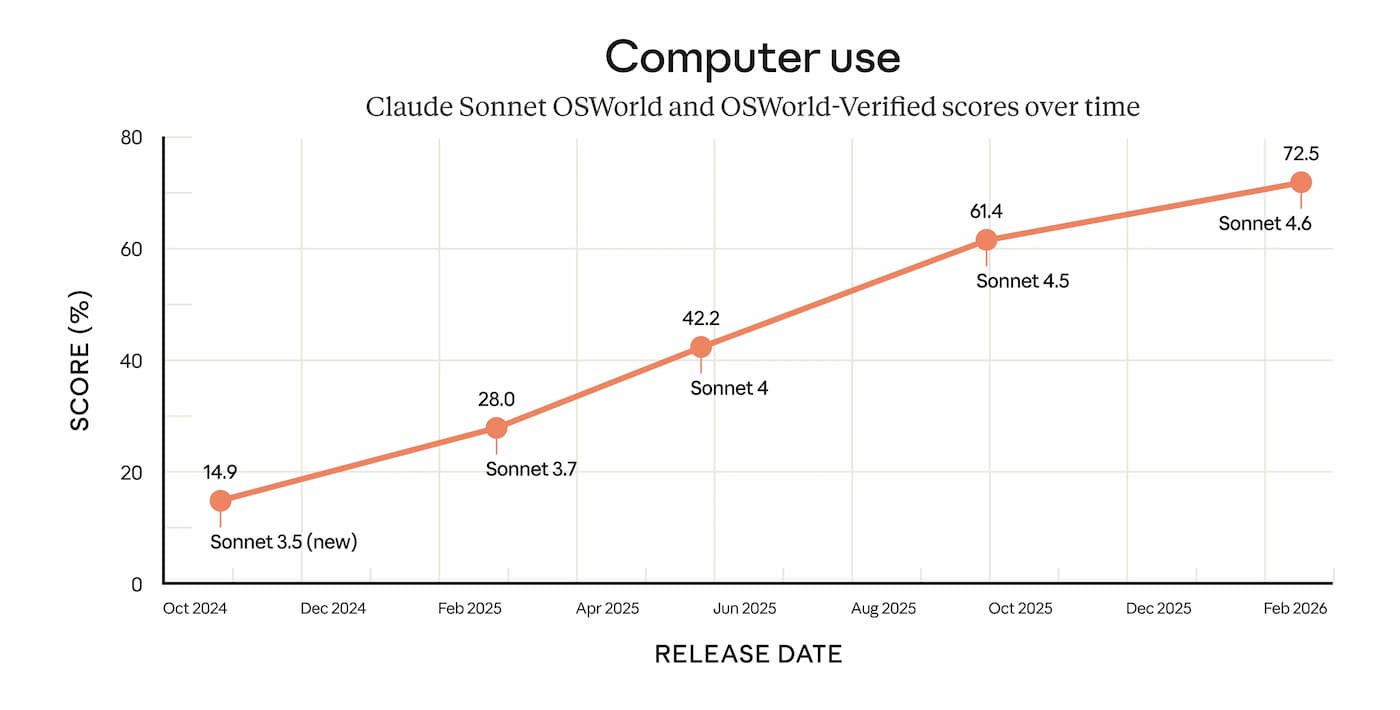
In everyday productivity scenarios, Sonnet 4.6 displays solid proficiency with popular tools such as browsers and office applications. According to a respected testing protocol, the model reached a 72.5% completion rate on tasks demanding subtle navigation and decision-making—ranging from spreadsheet manipulation to managing complex forms or navigating multiple browser tabs.
The following table illustrates the progression of success rates within the Sonnet series:
| Model | Success Rate (OSWorld-Verified) | Date |
|---|---|---|
| Sonnet – October 2024 | 14.9% | October 2024 |
| Sonnet 4.6 – February 2026 | 72.5% | February 2026 |
This remarkable progress reflects substantial investment in model refinement, delivering nearly human-like digital dexterity within mainstream office environments.
Accessible pricing meets widespread availability
The cost of using Claude Sonnet 4.6 ranges from $3 to $15 per million tokens. This pricing delivers exceptional value, especially considering the capabilities that typically belong only to flagship AI models.
With a simultaneous rollout across web portals, mobile apps, APIs, and cloud platforms, professionals and hobbyists alike gain immediate access to these advancements. Seamless integration into diverse workflows becomes standard, removing barriers to adoption.
Features welcoming all types of users
From launch day, both free and paid users enjoy full access to the latest capabilities. Features include improved file creation, integration with third-party applications, and intelligent conversation compression for managing lengthy dialog histories.
- Automatic assignment of Claude Sonnet 4.6 to every user tier
- New reasoning modes for deep technical and creative work
- Dynamic summarization of ongoing conversations to maintain continuity
One particularly valuable addition is conversational memory management. As discussions become more complex, the AI summarizes previous messages concisely. This ensures the flow remains uninterrupted during extended exchanges—a vital asset for professional communication or collaborative brainstorming.
Developer-centric enhancements and future prospects
The Claude Developer Platform receives targeted updates designed to empower engineers and creators. These include smart conversation compression and contextual code generation through automated web searches, streamlining research, debugging, and integration efforts.
Expectations run high within the developer community as they explore the limits of Sonnet 4.6’s reasoning engine. Earlier versions sometimes forced a trade-off between speed and clarity when working with massive repositories or complex collaborations. Now, smarter request routing and enhanced understanding mark a shift toward more natural and productive cooperation with AI-driven assistants.
Anticipated impact on competitive models
With favorable initial reviews and performance comparisons indicating that Sonnet 4.6 rivals or surpasses previous industry leaders, the broader market may feel compelled to reconsider pricing and access policies. Early adopters already benefit from faster iterations, increased confidence in automation, and smoother integration into daily routines.
As reliance on digital partners grows, accessible premium-grade options like Claude Sonnet 4.6 set new expectations for what AI should provide—both in terms of functionality and equitable access.
User feedback and continued evolution
The next phase will depend on real-world feedback from a rapidly expanding user base. Ongoing experimentation, critical analysis, and creative use cases will guide further refinements, while hallmark features such as efficient memory utilization and versatile platform deployment offer a vision of future AI experiences.
Each update aims to lower barriers and raise standards, ensuring that every iteration feels like a genuine leap forward rather than a minor adjustment. This philosophy drives the excitement surrounding Claude Sonnet 4.6 and cements its influence in the modern AI landscape.