

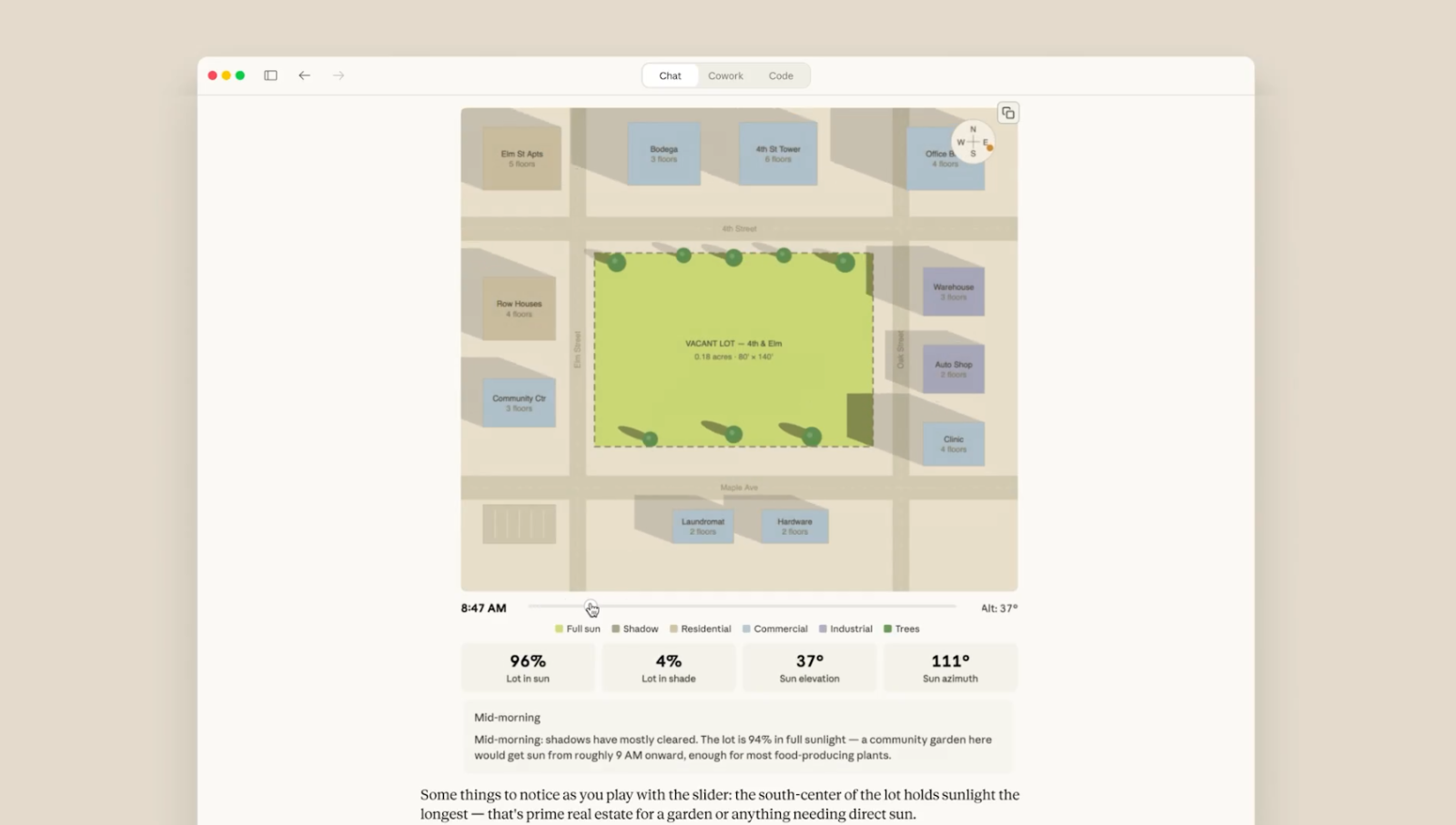
For years, chatbots have answered almost every question the same way: with blocks of text. But that paradigm may be changing.
Anthropic has introduced a new capability for Claude that allows the AI to respond not only with words, but also with interactive diagrams, charts, and visual explanations when those formats make an answer clearer.
The feature represents a major step toward a new generation of AI assistants designed to communicate ideas in the most intuitive format possible — even if that means replacing paragraphs with visuals.
Claude can now answer with diagrams instead of text
Claude can now build interactive charts and diagrams, directly in the chat.
Available today in beta on all plans, including free.
Try it out: https://t.co/tHPAZRgQkn pic.twitter.com/WXRrD4VkAt
— Claude (@claudeai) March 12, 2026
In a recent announcement, Anthropic revealed that Claude can automatically generate visual responses directly inside a conversation.
Rather than forcing users to explicitly request a chart or diagram, the AI decides when a visual representation would better explain a concept.
When that happens, Claude can produce:
- Interactive charts
- Technical diagrams
- Visual explanations of complex systems
- Educational illustrations
The visual appears directly within the chat interface, becoming part of the ongoing conversation rather than a separate file or image.
Interactive visuals that evolve during the conversation
What makes the feature particularly interesting is that the visuals are not static.
Unlike traditional image generation, where a picture is created once and remains unchanged, Claude’s diagrams can evolve as the conversation continues.
If a user asks follow-up questions, the AI can refine or update the visual representation accordingly. The chart, drawing, or diagram essentially becomes a living element of the discussion.
Users could even return to the conversation days later and continue interacting with the same visual explanation.
From periodic tables to structural engineering diagrams
Anthropic demonstrated the feature with several examples showing how visual reasoning can improve understanding.
In one case, a discussion about the periodic table generated an interactive version where each element could be clicked to reveal additional information.
In another example, a question about how weight is distributed in a building resulted in a structural diagram illustrating the forces acting on different parts of the structure.
These visuals then became reference points for the rest of the conversation, helping the AI explain more complex ideas step by step.
The next frontier: AI that chooses the best way to explain things
The move reflects a broader shift happening across the AI industry.
Until recently, generative AI focused primarily on producing increasingly sophisticated text responses. The next stage of development is about choosing the most effective format for communication.
Sometimes that will still be text. But in other cases, a chart, diagram, or visual explanation may be far more efficient.
Anthropic’s approach suggests a future where AI assistants dynamically select the best medium to convey information — rather than forcing users to specify it.
The new arms race between AI assistants
Anthropic is not alone in pursuing this direction.
OpenAI has already integrated visual explanations and diagrams into ChatGPT, while Google’s Gemini can generate educational images on demand.
The competition between leading AI companies is now expanding beyond raw intelligence or model size. The focus is shifting toward how clearly and intuitively AI can communicate knowledge.
In other words, the future of AI may not just be about answering questions — but about explaining ideas in ways that humans understand instantly.
And sometimes, the clearest answer isn’t a paragraph at all.
