

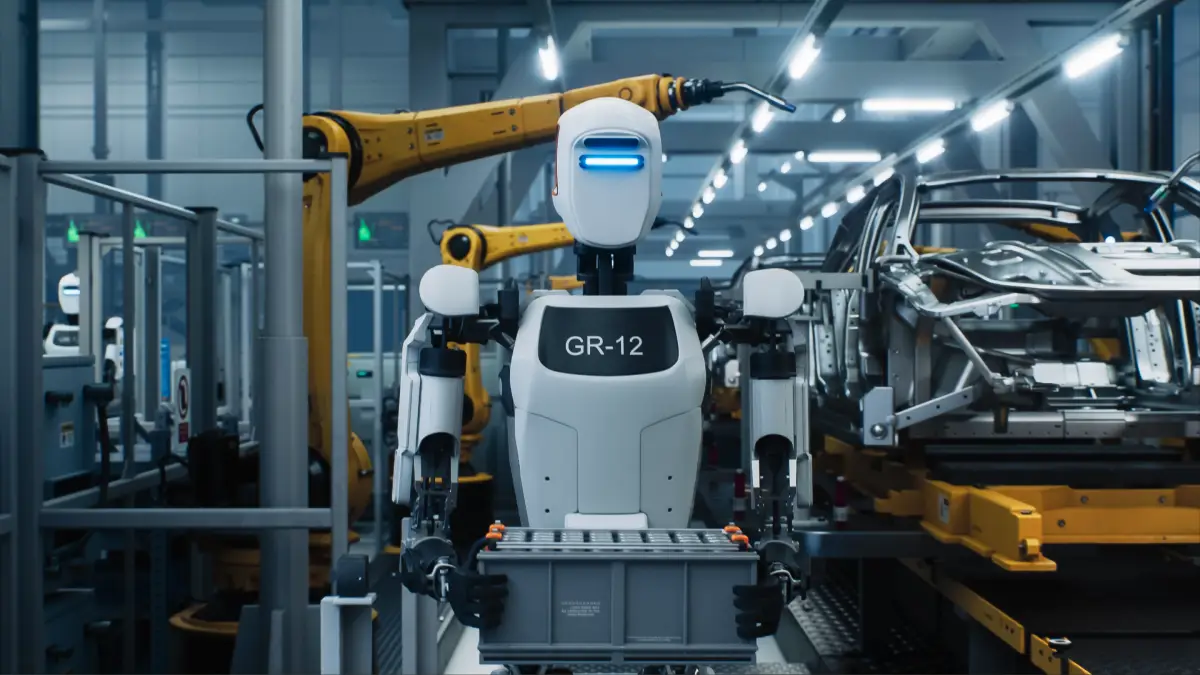
Something significant is unfolding within China’s automotive sector: an unprecedented shift toward fully automated car manufacturing.
Assembly lines already feature synchronized robots handling welding, painting, and part manipulation.
However, the next leap involves entire factories operating without a single person present.
Set to debut before 2030, these so-called “ghost plants” not only showcase technical prowess but also signal a profound transformation for global industry.
Robots take over every stage of auto production
For decades, robots have played a crucial role in vehicle production, especially when it comes to repetitive or hazardous tasks. Yet, essential steps such as final assembly largely relied on human workers—until now.
China is pushing further than previous initiatives by automakers worldwide, eliminating the need for any physical labor inside the plant. Every process, from shaping metal sheets to installing complex electronics, will be managed entirely by smart machinery.
This radical approach brings about a striking consequence: there is no longer any requirement for bright lighting, heating, or ergonomic workstations built for humans. Machines can function continuously, guided by sensors and algorithms—even in total darkness.
This marks the beginning of a new industrial era where vehicles are manufactured in environments more reminiscent of science fiction films than traditional workshops.
- Continuous 24/7 operation without breaks
- No reliance on traditional shifts or daylight
- Energy savings due to minimal lighting and reduced maintenance needs
How total automation is spreading beyond factories
The concept of full autonomy extends beyond manufacturing spaces.
In recent years, robotics technology has become increasingly visible in city life across China. In many urban areas, robots manage daily functions such as monitoring intersections, conducting patrols, and collecting vast amounts of real-time data to optimize traffic flow.
This nationwide adoption showcases more than just technological progress; it reflects a willingness to rethink the very nature of work and supervision.
By relying on artificial intelligence and integrated sensor networks, industries are designing environments from scratch where human intervention is minimized, if not eliminated altogether.
Automation in public services and logistics
Outside factory walls, automation shapes transportation systems and logistical operations. Driverless cargo vehicles transport goods between warehouses, while autonomous delivery robots navigate busy streets to reach homes and businesses. These advancements reflect a broader vision focused on efficiency and responsiveness.
Compared to conventional approaches—where unpredictable factors often cause delays—robotic management enables orchestration on a scale previously unimaginable.
The synergy between logistics and AI-driven analysis rapidly optimizes freight routes, reducing costs and environmental impact throughout the supply chain.
Impact on heavy industry and infrastructure projects
While ghost factories capture headlines, similar automation principles are transforming heavy industries and large-scale infrastructure development.
Construction sites increasingly use modular robotics to assemble sections of bridges or buildings. Machine-learning software monitors equipment health and safety margins in real time, allowing predictive interventions without direct oversight.
The result is a dramatically streamlined system for organization, scheduling, and risk management. Where hundreds of workers once coordinated tight deadlines and shifting priorities, AI-led planning dynamically reallocates resources to maximize productivity and safety.
Challenges and transformations for the global workforce
The arrival of fully automated plants promises undeniable gains in speed, consistency, and profitability. However, it raises fundamental questions regarding employment and regional economies. Manufacturing jobs that once formed the backbone of communities are now facing intense disruption or even elimination.
Advanced facilities still require teams of specialists for maintenance, engineering, and digital oversight, but the number of routine positions drops sharply. Those who previously operated machines may transition toward remote monitoring or maintaining intricate software platforms. Regions dependent on factories must therefore anticipate sweeping economic changes and invest heavily in retraining and education programs.
Future outlook of global competition in the auto industry
China’s rapid move toward fully automated car plants intensifies competition with Western manufacturers. Established brands elsewhere have adopted partial automation to address rising costs and evolving technologies. Nonetheless, some of the most critical procedures—such as wiring harness installation—still rely on skilled hands rather than robotic grippers. Today, breakthroughs in modular components and tightly integrated systems enable new-generation robots to tackle challenges that stumped earlier designs.
If Chinese factories achieve total autonomy ahead of rivals, their example could redefine benchmarks for both productivity and resilience. Other nations aiming to retain or regain leadership will need to overhaul not only technical strategies but also social policies related to workforce transitions.
