

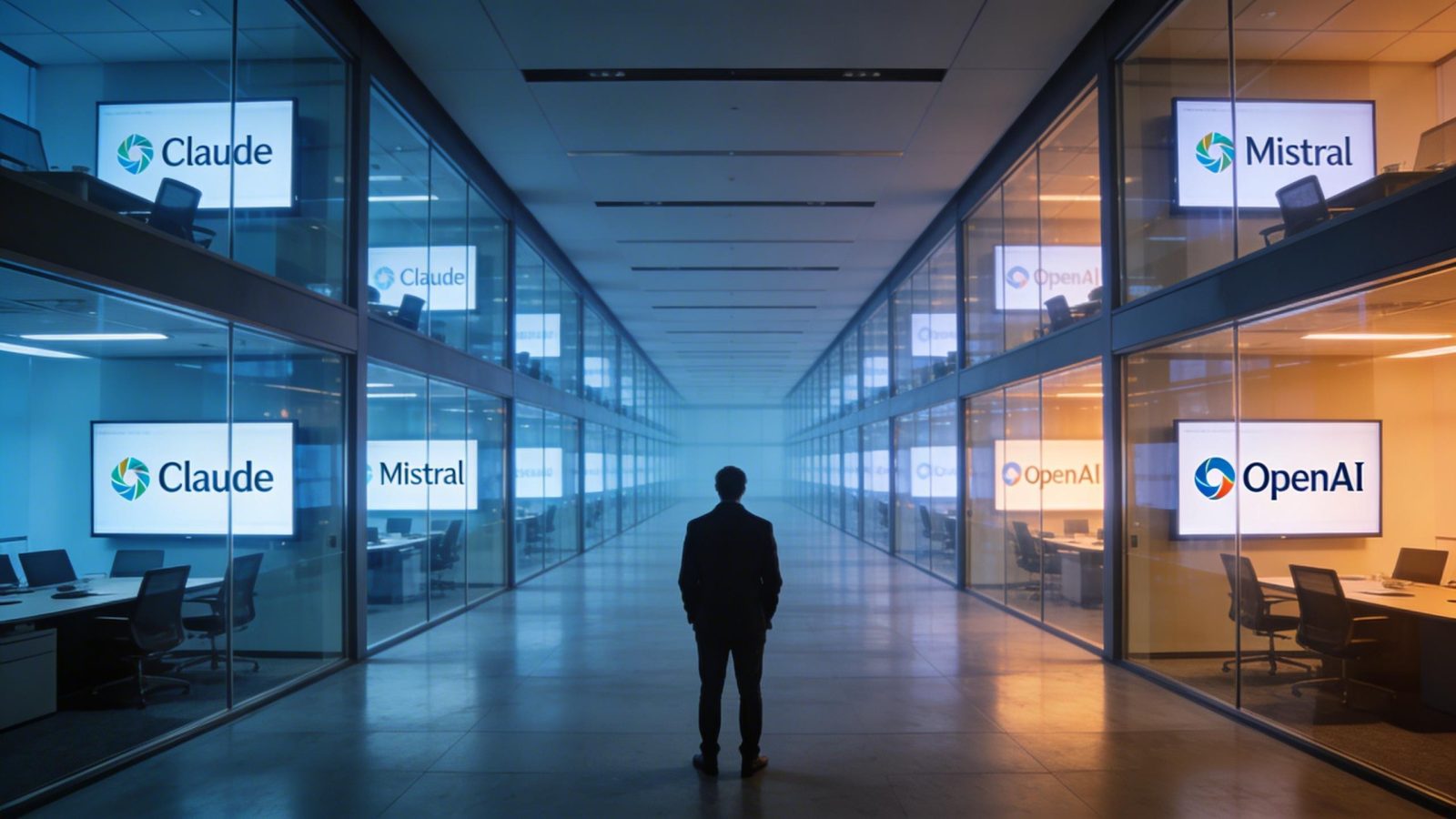
Accenture just locked in a multi-year partnership with Mistral AI on February 26, 2026—the kind of splashy deal that’s supposed to signal commitment. But here’s what the press release won’t tell you: Accenture already trained 30,000 employees on Anthropic’s Claude just two months earlier. This isn’t a bet on European AI sovereignty. It’s a hedge.
The real story isn’t that Mistral landed a marquee consulting client. It’s that even Accenture—a $64 billion consulting empire with more enterprise relationships than most startups have employees—can’t figure out which AI will actually deliver ROI. So they’re buying insurance policies across the entire market.
That should worry anyone paying consultant fees to “scale AI solutions.”
Accenture’s multi-vendor playbook exposes the industry’s dirty secret
Accenture’s Claude training deal from December 2025 made Anthropic one of the firm’s top three enterprise AI customers. Now Mistral gets the same treatment. Financial terms? Undisclosed. Deployment timelines? Not mentioned. Success metrics? Nowhere.
This is portfolio diversification dressed up as strategic partnership. And it makes sense—if you’re Accenture. The EU AI Act pressure makes Mistral’s European data sovereignty pitch genuinely compelling for regulated industries. GDPR nightmares alone justify having a non-U.S. option in the stack.
But Accenture’s simultaneous partnerships with Mistral and Anthropic’s enterprise push into healthcare reveal something uncomfortable: nobody—not even the consultants charging premium fees—knows which AI will survive enterprise scrutiny. They’re hedging because the alternative is picking wrong and losing billions in future bookings.
The pattern follows broader enterprise AI vendor decisions driven more by regulatory compliance than proven performance.
Mistral isn’t the European underdog anymore—and that changes nothing
Let’s kill the “scrappy EU startup” narrative right now. Mistral’s client roster includes IBM, Cisco, SAP, Stellantis, and ASML. These aren’t pilot projects. They’re Fortune 500 deployments at companies that don’t experiment with unproven tech.
And Mistral has real money behind it—though not quite the $1.5 billion ASML investment at a $14 billion valuation that some 2025 reports suggested. (That figure appears to conflate multiple funding rounds and hasn’t been confirmed by recent sources.) What we do know: Mistral is well-capitalized enough to compete on equal footing with U.S. rivals.
But here’s the problem.
Zero public metrics on deployment success. No disclosed ROI data. No client retention numbers. Just a list of impressive logos and vague promises about “scalable AI solutions.” Accenture’s Advanced AI business is growing—revenues reportedly hit significant year-over-year increases—but the firm doesn’t break down per-deployment costs or typical engagement fees.
Translation: enterprises are paying consultant premiums for AI deployments that may or may not work, and nobody’s publishing the scorecards. The workforce retraining push—30,000 employees learning Claude—reflects broader anxiety about AI reshaping high-skill work across consulting. But retraining isn’t the same as proven implementation.
The sovereignty pitch works until someone asks for proof
Mistral’s competitive edge against OpenAI and Anthropic is real: European data sovereignty matters under EU AI Act rules. Developer communities on HN and Reddit praise the “GDPR-friendly” positioning. One thread from February 27 captured the mood: “Finally, an EU model that doesn’t phone home to California—Accenture hedging is smart for GDPR nightmares.”
Fair point. But skeptics in the same forums noted consultants are “just reselling AI now” without proven metrics. And they’re right. The Accenture partnership announcement reads like every other consultant AI deal: big promises, undisclosed financials, no verifiable performance benchmarks.
The lack of public deployment metrics echoes broader concerns about AI deployment failures in real-world enterprise environments. Mistral’s open-source positioning doesn’t automatically guarantee enterprise-grade reliability. And “strategic autonomy” sounds great in a press release—less great when you’re explaining to the CFO why the AI transformation project is six months behind schedule.
The question isn’t whether European AI can compete with U.S. giants. It’s whether any enterprise AI—European or American—can prove it’s worth the consultant fees before the hype cycle crashes.
