

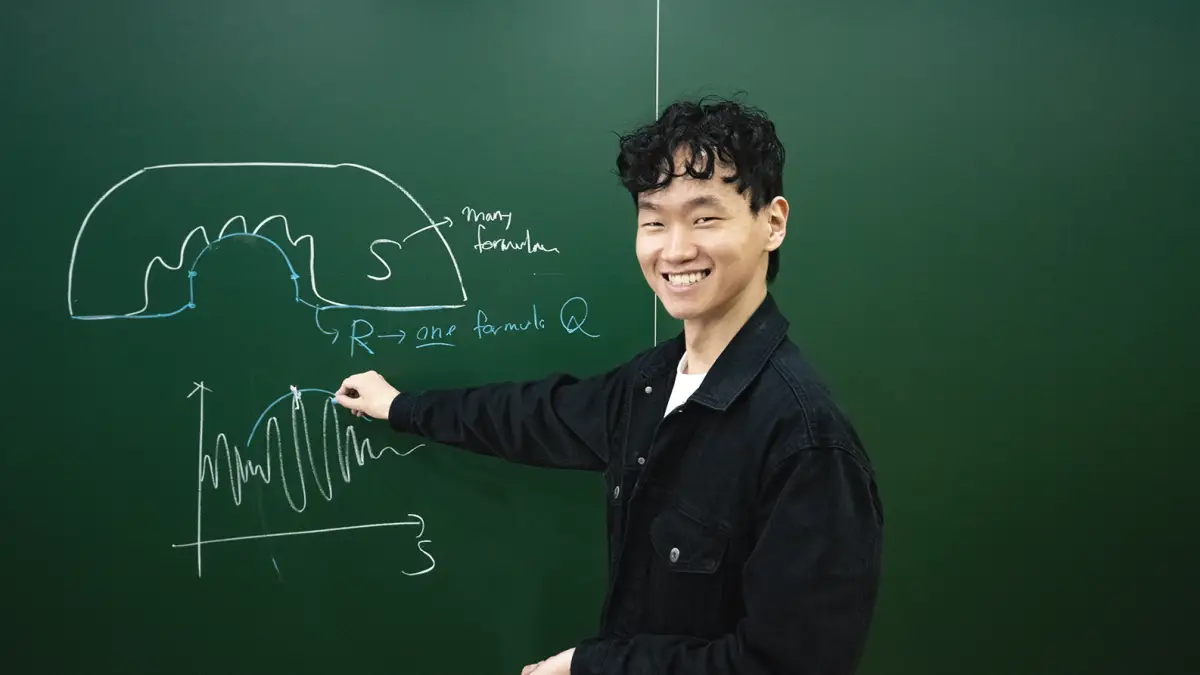
Some mathematical mysteries linger for generations, captivating those who hope to leave their mark on the field. Recently, Baek Jin-eon, a 31-year-old mathematician from South Korea, accomplished something truly remarkable—he resolved the infamous moving sofa problem that had stumped even the brightest minds since 1966. His achievement stands out not only for the solution itself but also for his unique approach and determination in an era dominated by computational methods.
What is the moving sofa problem?
The moving sofa problem poses a deceptively simple question: what is the largest two-dimensional shape that can be maneuvered around a right-angled hallway corner? Beneath this straightforward premise lies a maze of complex geometry, which has confounded mathematicians worldwide for decades. The challenge became legendary because it requires a blend of creativity and precision, and until now, no one could provide an exact answer.
This geometric puzzle first gained prominence in the mid-1960s, consistently drawing attention as researchers searched for elegant solutions or clever workarounds. Despite countless efforts and incremental advances, the ultimate answer remained elusive, adding to its mystique within the mathematical community.
Progress before Baek Jin-eon’s breakthrough
Mathematicians have long refused to abandon the pursuit of the moving sofa solution. Over the years, each new generation brought fresh tools and perspectives, leading to gradual improvements. Notably, Joseph Gerver, an American mathematician, made waves in 1992 with a curved figure that increased the best-known area to approximately 2.2195 square meters. This shape quickly became the standard-bearer for progress on the problem.
However, despite the use of advanced simulations and exhaustive computer modeling, no one could definitively prove whether Gerver’s figure was truly optimal. The mathematical community remained captivated by the possibility that someone might discover a subtle yet significant improvement.
Baek Jin-eon’s pure logic triumph
What distinguishes Baek Jin-eon’s accomplishment is the rigorous and traditional path he chose. Rather than relying on computers, which have become central to modern mathematical research, Baek embraced classic mental labor—a process rooted in deep logical reasoning. He dedicated seven years to this challenge, progressing from doctoral studies at the University of Michigan to postdoctoral research in South Korea, always keeping the moving sofa problem as a constant focus.
During his mandatory military service at the National Institute for Mathematical Sciences, Baek encountered the problem more formally, igniting years of personal commitment. According to those familiar with his journey, unlike previous researchers who used extensive software-driven simulations, Baek relied exclusively on deduction, pen, and paper. His efforts culminated in a 119-page proof filled with intricate arguments and demonstrations.
Recognition and impact in the scientific community
Following the publication of his findings, major institutions took notice. Prestigious publications such as Scientific American recognized his work as one of the most significant mathematical achievements of 2025. For Baek, however, recognition did not signify an endpoint. Instead, he viewed the discovery as a starting point for further exploration, demonstrating how breakthroughs often inspire new ambitions across the discipline.
His detailed paper is currently under formal review at the Annals of Mathematics, one of the world’s most selective mathematical journals. As experts meticulously evaluate every step of his proof, excitement continues to build among peers. Should his resolution be officially validated, it may influence future approaches to mathematical problems—potentially encouraging a return, at least in part, to traditional forms of reasoning rather than exclusive reliance on computation.
The mindset behind mathematical breakthroughs
Beyond the technical aspects, Baek Jin-eon’s story highlights the human side of theoretical research. He recalls discovering his passion for mathematics during elementary school and envisioning a lifelong dedication to mathematical inquiry. Over time, this enthusiasm fueled his perseverance through cycles of optimism and frustration—a rhythm well known to anyone involved in pure science.
Today, working at the June E Huh Center for Mathematical Challenges in South Korea, Baek views mathematics as a series of dreams and realizations. Progress often emerges from disappointment; discarded ideas can spark better ones as research evolves. This perspective illustrates why persistent curiosity so often leads to extraordinary insights—results that cannot be planned in advance, but remain accessible to those willing to invest long hours in careful thought.
Key moments and facts from Baek Jin-eon’s journey
- Began studying the problem during undergraduate studies and military research in South Korea.
- Dedicated a total of seven years to exploring the moving sofa problem, both in the United States and Korea.
- Employed only deductive reasoning and classical techniques, deliberately avoiding computer simulations.
- Shared his findings online, sparking discussion within the global mathematical community.
- Received major accolades and consideration by top academic publishers for his groundbreaking proof.
Comparing techniques: pure logic versus computer methods
It is easy to assume that technology alone solves today’s toughest puzzles. Yet Baek Jin-eon’s experience offers a compelling alternative. While many leaned on ever-increasing computational power, Baek trusted persistence and logical clarity, drawing on classic problem-solving traditions refined over decades.
This contrast provides a valuable lesson for aspiring mathematicians: although sophisticated hardware can assist, lasting contributions often arise from deep thought, careful analysis, and creative flexibility. Baek’s journey demonstrates that there remains ample room for both approaches as future generations tackle seemingly impossible questions.
| Contributor | Year | Method used | Main result |
|---|---|---|---|
| Joseph Gerver | 1992 | Computer-assisted curve design | 2.2195 m² shape found |
| Baek Jin-eon | 2024 | Pencil-and-paper proof | Proof of optimality of Gerver’s shape |
