

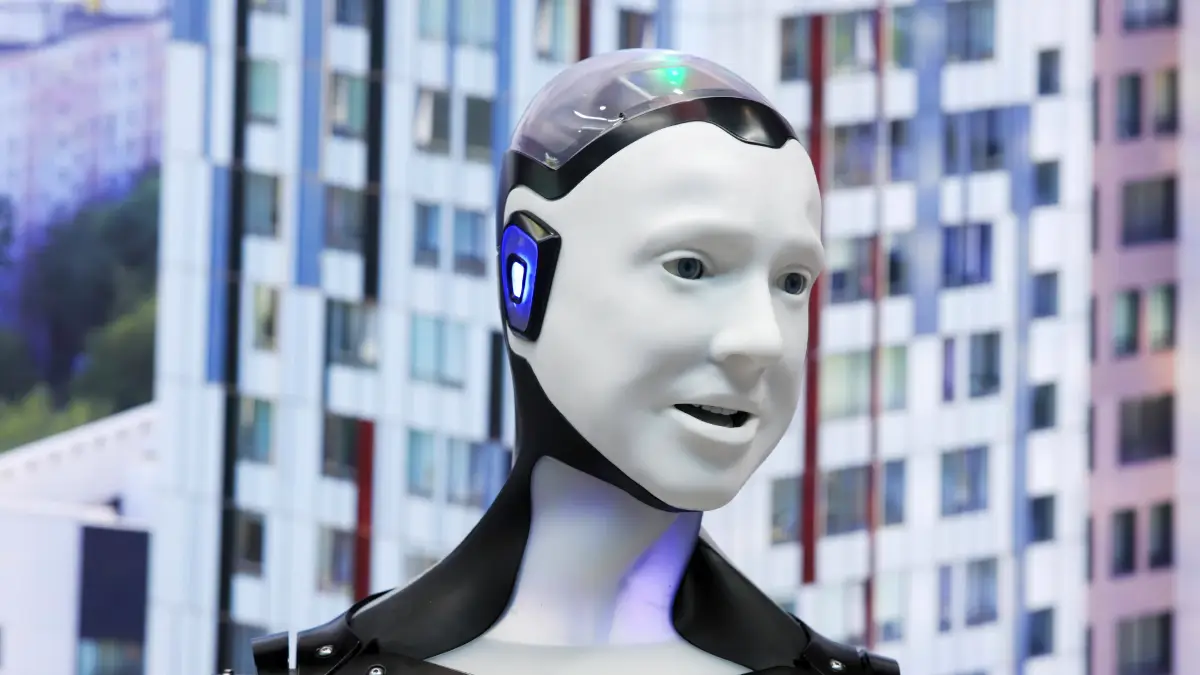
Watching a robot move its lips is easy. Watching a robot actually sound human is something else entirely.
A team of researchers has just crossed that line — by teaching a humanoid robot how to speak simply by letting it watch YouTube videos.
The result is impressive. And, for many viewers, deeply uncomfortable.
The moment AI gets a face
Artificial intelligence is no longer confined to screens and servers. The next phase is already here: physical AI.
These systems don’t just generate text or images. They occupy space. They look at us. And now, they are learning how to speak like us.
According to a new study published in Science Robotics, researchers at Columbia University have successfully trained a humanoid robot to synchronize lip movements with speech — a key ingredient in making robots feel “alive.”
The robot features a flexible face powered by 26 tiny motors, allowing it to reproduce subtle expressions, mouth shapes, and micro-movements usually associated with human speech.
Learning speech the human way
Before watching anyone else speak, the robot had to understand itself.
Researchers placed it in front of a mirror. Like a child discovering its reflection, the machine observed how its own face changed as motors activated.
Using a vision-language-action (VLA) model, the system learned how internal movements translated into visible expressions.
Only once it mastered its own facial mechanics did the real training begin.
YouTube became its teacher
The robot was then exposed to hours of YouTube footage showing people talking and singing.
Different faces. Different accents. Different languages.
By observing how lips move in sync with sound, the robot learned to replicate those movements in real time.
The result? A humanoid capable of lip-syncing in English, French, Japanese, Korean, Spanish, Italian, and German.
Demonstration videos released by the research team show the robot speaking convincingly — close enough to human speech to trigger a visceral reaction in many viewers.
The uncanny valley problem
The system isn’t perfect yet. Certain sounds — especially “B” and “W” — still cause noticeable mismatches between audio and lip movement.
But researchers are confident these issues will fade with continued training.
“When accurate lip synchronization is combined with conversational AI like ChatGPT or Gemini, it adds a whole new layer to human–robot interaction,” explains Yuhang Hu, one of the study’s authors.
In other words: once robots can talk, listen, and look human — our relationship with them changes.
Why this makes people uneasy?
This research aims to solve a long-standing issue in robotics: the uncanny valley.
When robots appear almost human — but not quite — people tend to feel discomfort rather than connection.
Ironically, making robots more realistic is also what makes them unsettling in the first place.
By improving lip synchronization and facial realism, researchers hope to cross that valley entirely — turning unease into familiarity.
Whether that future feels exciting or disturbing may depend on how comfortable we are watching machines slowly learn how to be us.
