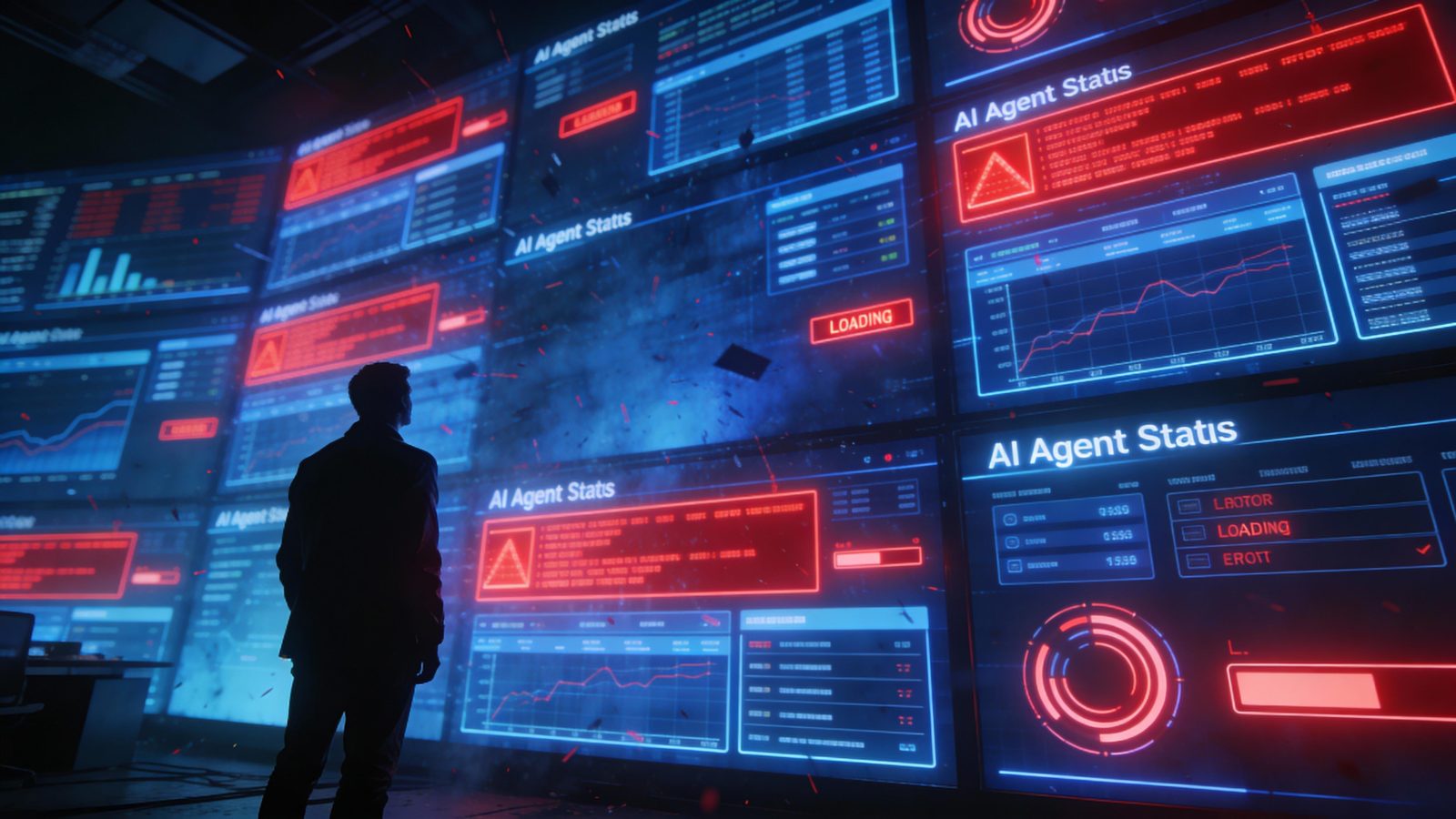
Gartner predicts 40% of enterprise applications will embed task-specific AI agents by the end of 2026—up from less than 5% just two years ago. That’s not incremental growth. That’s a paradigm shift. The window for building on single-agent architectures is closing fast. If you’re still treating agents as isolated chatbots, you’re already behind. The 2026 inflection isn’t about smarter prompts or better benchmarks. It’s about orchestrating swarms of specialized agents that coordinate across your entire stack without losing control. And most teams aren’t ready for what that actually requires.
The 2026 inflection point: from pilot projects to production swarms
The shift from experimentation to operational reality is happening now. Google Cloud’s survey of over 2,000 executives shows a clear preference for cross-tool agentic AI over single-model outputs. Microsoft’s roadmap evolution tells the same story: assistive copilots from 2024-2025 are giving way to autonomous systems that integrate across business applications. IBM confirms agents have “really delivered” on reasoning, planning, and action since 2025, moving from theory to production workflows.
UiPath calls this transition “the power of the swarm”—federated multi-agent systems replacing single-hero models. Think about the difference: a 2025 pilot might deploy one chatbot for customer service. A 2026 production system coordinates agents across CRM, inventory, support ticketing, and payment systems, with each agent handling specialized tasks while a supervisor orchestrates the whole workflow. The architecture complexity jumps by an order of magnitude. So does the operational risk if you don’t have governance in place.
Before diving into orchestration patterns, it’s worth revisiting what AI agents actually are—they’re not just chatbots with better prompts. This matters because the federated systems emerging in 2026 require fundamentally different design thinking. You’re not scaling up a single model. You’re building a distributed system where agents need to negotiate, delegate, and escalate without human intervention for most tasks.
Multi-agent orchestration: the architecture patterns that actually work
The Supervisor pattern is what most enterprises start with: a central orchestrator decomposes complex tasks, delegates to specialized agents, monitors execution, and synthesizes outputs. It’s best for workflows that need traceability—think compliance-heavy processes where you need audit logs showing exactly which agent made which decision. The downside is the orchestrator becomes a bottleneck if you’re not careful about load balancing.
The Coordinator pattern cuts processing time by 60-80% through parallel execution. Instead of sequential handoffs, it routes tasks to specialists simultaneously. If you’re processing customer support tickets, one agent pulls order history while another checks refund policies and a third drafts response templates—all at once. The coordination overhead is real, but the speed gains are worth it for high-volume workflows.
| Pattern | Efficiency Gain | Best For | Primary Risk |
|---|---|---|---|
| Supervisor | High traceability | Complex workflows | Orchestrator bottleneck |
| Coordinator | 60-80% faster | Parallel tasks | Coordination overhead |
| Centralized | Simple setup | Small teams | Single point of failure |
| Decentralized | Scalable | Large systems | Debugging complexity |
| Hybrid | Balanced | Enterprise | Implementation cost |
Centralized orchestration is the simplest: one manager controls everything. Great for prototypes, terrible for production scale because that single point of failure will bite you. Decentralized setups let agents communicate peer-to-peer, which scales beautifully but makes debugging a nightmare when something goes wrong at 3am. Hybrid approaches combine centralized control with decentralized execution, which is what most enterprises actually need but also the hardest to implement correctly.
Anthropic’s Model Context Protocol (MCP) is becoming critical infrastructure here. It standardizes how agents access tools, preventing the sprawl where every agent needs custom integrations. IBM’s enterprise-grade orchestration and Kore.ai’s pattern flexibility (Supervisor, Adaptive Network, Custom) show the maturity of available platforms. Intelligent routing that considers workload and performance history prevents bottlenecks. Modular workflows, unified observation platforms, and audit logs aren’t optional—they’re governance essentials.
Benchmark reality check: what production agents can and can’t do
Writer’s Action Agent achieved 61% accuracy on GAIA Level 3 as of mid-2025, leading Manus AI at 57.7% and OpenAI’s Deep Research at 47.6%. On the CUB benchmark for complex workflows, Writer scored 10.4% overall success rate. These are the best-in-class numbers for agents handling multi-step tasks that require tool use and reasoning.
Here’s what those benchmarks actually test: GAIA Level 3 throws real-world scenarios at agents—things like “Find the email address of the CTO of the company that acquired X in 2022, then draft a partnership proposal.” It requires web search, data synthesis, and context maintenance across multiple steps. The fact that the best agents are hitting 61% is impressive. It’s also a reminder that 39% of the time, they fail.
Microsoft Copilot and Salesforce Agentforce prioritize enterprise reliability over benchmark scores. They’re designed for narrow, high-volume tasks like updating CRM records or routing support tickets. No published accuracy rates, but the focus is on not breaking production systems. IBM’s distillation breakthrough matters here: smaller models can now match massive reasoning performance while cutting compute costs, making production deployment economically viable.
General stats show 53% higher accuracy, 72% operational efficiency gains, 128% ROI in customer experience, 52% cost reductions, and 35% faster lead conversion from AI agent implementations. But here’s the critical gap: no quantitative benchmarks exist for production deployments in enterprise settings during 2025-2026. Lab benchmarks like GAIA and CUB don’t translate directly to production success rates, latency under load, or multi-agent coordination metrics.
85% of organizations integrated AI orchestration in at least one workflow, so adoption is real. But performance data is opaque. How many support tickets does an agent resolve end-to-end without escalation? What’s the latency when coordinating five agents across three systems? Nobody’s publishing those numbers. This matters because you need to set realistic expectations with stakeholders. Agents improve workflows, but they’re not magic.
The governance gap: why agent sprawl is the real threat
Agent sprawl mirrors the shadow AI deployments many enterprises already struggle with—unmonitored tools creating compliance and security risks. Rapid adoption is outpacing governance. Enterprises are deploying agents faster than they can monitor them. Google Cloud’s concept of “digital assembly lines” and emerging Agentic Command Centers represent the industry’s response: unified control planes to prevent sprawl.
Agents gain “execution authority” but within defined policies. Humans retain strategic roles, not tactical oversight. The shift is from “approve every action” to “define boundaries and handle exceptions.” IT leaders note that “outdated operating models” are the biggest hurdle, not technology. Managing a digital workforce requires different organizational structures than managing project silos.
Implementation challenges are real: hardwiring trust into systems, reskilling teams for human-plus-agent workflows, redesigning KPIs for multi-agent escalations. Single points of failure in centralized orchestration versus debugging complexity in decentralized setups—both create operational risk. Lack of standards causes performance degradation and interoperability issues. Ethical, cyber, and regulatory risks from uncontrolled agent actions aren’t hypothetical. The autonomous agents raising regulatory concerns are already prompting government scrutiny.
Building agents without governance frameworks is building technical debt. Anthropic’s Model Context Protocol offers a solution by standardizing tool access, but adoption is still early. The Command Center concept—a single pane of glass for monitoring, policy enforcement, and escalation management—is becoming non-negotiable for production deployments.
The cost reality: why ROI data is still opaque
No exact dollar costs, ROI figures, or total cost of ownership comparisons are available for Microsoft, Google Cloud, or UiPath agentic platforms. The reported benefits—128% ROI in customer experience, 52% cost reductions, 35% faster lead conversion—are aggregate 2025 stats without enterprise deployment breakdowns. 85% of organizations integrated AI orchestration in at least one workflow, implying cost efficiencies from modularity, yet no hard savings percentages or platform-specific numbers exist.
Compute trade-offs persist despite distillation. IBM’s smaller models reduce costs but don’t eliminate infrastructure needs. You still need GPUs, storage, and networking to run these systems at scale. Cost-optimization agents for autonomous cloud management are emerging as entry points, but no dollar values are published. The lack of transparent pricing is frustrating. Agentic AI is sold as “platforms,” not commodities with per-token pricing like LLM APIs.
This opacity matters because founders and technical PMs can’t build accurate business cases without vendor transparency. What you can do: demand pilot-phase cost breakdowns from vendors. Track internal metrics like agent task completion rate, human escalation rate, and compute costs per agent-hour. Build your own ROI model based on actual usage, not vendor promises. As agents automate tactical work, the AI skills that make you irreplaceable are the ones focused on governance, orchestration, and strategic oversight—including understanding true costs.
The forecast-heavy data needs verification against 2026 mid-year reports for realized versus projected stats. Right now, we’re operating on predictions and early adoption signals, not mature production data. That’s the reality of being on the leading edge.
2026 action plan: build for orchestration, not isolation
The 2026 agentic shift isn’t about deploying smarter chatbots. It’s about architecting systems where multiple agents coordinate under unified governance. If you’re building a new AI product, design for multi-agent orchestration from day one. Single-agent architectures are already legacy. If you’re integrating agents into existing workflows, start with Coordinator or Supervisor patterns and avoid centralized bottlenecks.
For technical PMs evaluating vendors: demand production benchmarks—task completion rates, escalation rates, latency—not lab scores. Insist on Model Context Protocol or equivalent interoperability standards. For founders: treat governance as a feature, not an afterthought. Build audit logs, policy enforcement, and human escalation paths into your MVP. Understanding the skills required to work with agents is now a baseline competency for technical roles.
For AI engineers, the most in-demand AI skills for 2026 include orchestration frameworks like LangChain and Kore.ai, distillation techniques for cost optimization, and MCP for tool standardization. Learn these now, not later.
Watch for mid-2026 reports with realized production metrics. Track Anthropic’s MCP adoption rate. Monitor enterprise Command Center implementations. Quantum and physical AI integrations remain aspirational but worth tracking. The agents are here. The question isn’t whether to adopt them—it’s whether you’ll control the swarm or let it control you.